Apex vs Take Profit Trader: Prop Firm Comparison
Written By: Patrick Wieland
Choosing the right prop firm can determine whether your trading career grows or stalls.
With dozens of firms offering evaluations, traders often focus on two of the most recognized names in the futures funding space: Apex Trader Funding and Take Profit Trader.
Both firms offer funded trading opportunities, but their rules, payout structures, and evaluation models differ in ways that can significantly impact a trader’s experience.
Understanding those differences is essential before committing to an evaluation.
What Is a Futures Prop Firm?
A futures prop firm provides traders with access to capital in exchange for following predefined risk rules.
Instead of trading personal funds, traders complete an evaluation designed to demonstrate:
-
Risk management discipline
-
Consistent trading performance
-
Ability to operate within drawdown limits
Once a trader passes the evaluation, they gain access to a funded account where profits are shared with the firm.
While the concept sounds simple, each firm structures its rules differently.
Overview of Apex Trader Funding

Apex Trader Funding has become one of the largest futures prop firms in the industry.
Its rapid growth comes from aggressive pricing promotions and a large community of traders using the platform.
Key Characteristics
Apex is known for:
-
Large evaluation account options
-
Frequent promotional discounts
-
The ability to manage multiple accounts simultaneously
Many traders are attracted to Apex because of the scaling potential once they become funded.
Potential Challenges
However, Apex also includes rules traders must understand clearly, including:
-
Trailing drawdown structures
-
Profit consistency requirements
-
Position size limits based on account tiers
These rules reward disciplined traders but can eliminate aggressive traders quickly.
Overview of Take Profit Trader

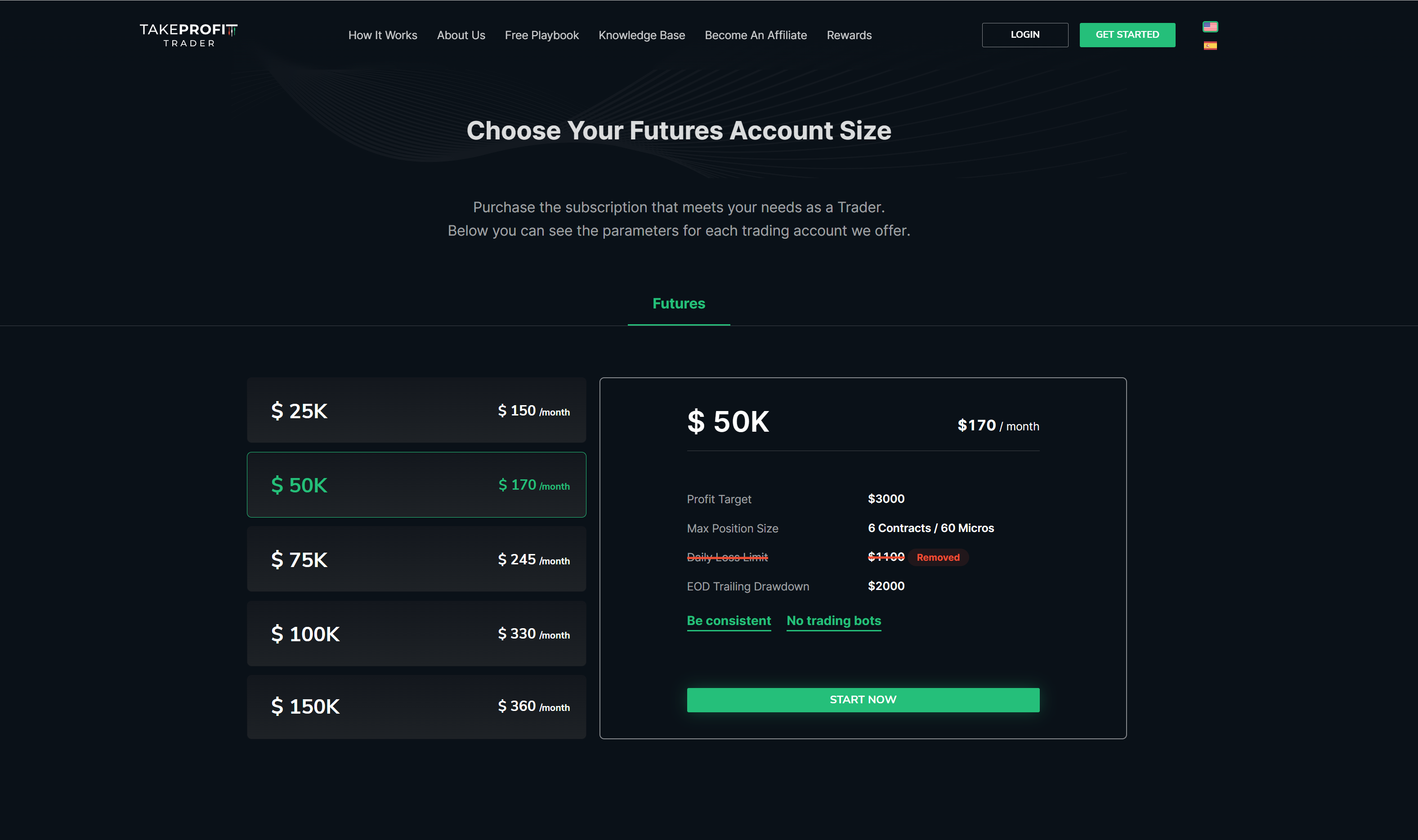
Take Profit Trader has gained attention for offering a more straightforward rule structure.
Rather than focusing on large scaling potential, the firm emphasizes simplicity and clear evaluation guidelines.
Key Characteristics
Take Profit Trader is known for:
-
Simple evaluation requirements
-
Transparent rule structures
-
Straightforward payout qualification
Many traders prefer the clarity offered by these rules, especially those new to prop trading.
Potential Challenges
While the rules are simpler, traders still need to respect:
-
Daily loss limits
-
Maximum drawdown thresholds
-
Minimum trading requirements
Like any prop firm, success depends on discipline rather than speed.
Comparing the Evaluation Structure
The evaluation phase is where most traders spend their time.
While both firms aim to assess trading discipline, their approaches differ slightly.
Apex Evaluation Model
The Apex evaluation focuses heavily on managing a trailing drawdown.
This structure rewards traders who:
-
Build profit gradually
-
Maintain consistent risk levels
-
Avoid large swings in equity
Traders who attempt to pass aggressively often run into drawdown limits quickly.
Take Profit Trader Evaluation Model
Take Profit Trader’s evaluation tends to feel more straightforward.
The rules are clearly defined and focus on maintaining controlled risk exposure while reaching the profit target.
This approach appeals to traders who prefer simplicity and transparency.
Payout Structure Comparison
For most traders, payouts are the ultimate goal.
Both firms allow traders to withdraw profits once certain conditions are met, but their payout qualification rules differ.
Apex Payout Considerations
Apex payouts typically depend on:
-
Meeting profit consistency guidelines
-
Maintaining rule compliance during trading periods
-
Following the firm’s payout schedule
Many traders are attracted to the scaling potential once they establish a consistent record.
Take Profit Trader Payout Considerations
Take Profit Trader focuses on simpler payout qualification rules.
Traders who meet the firm’s criteria can request withdrawals according to the platform’s payout structure.
Clarity in these rules helps traders plan their trading activity more easily.
Which Prop Firm Is Better for New Traders?
The answer depends on the trader’s personality and experience level.
Apex May Be Better If You:
-
Want higher scaling potential
-
Are comfortable managing trailing drawdown
-
Prefer the flexibility of multiple accounts
Take Profit Trader May Be Better If You:
-
Prefer simpler evaluation rules
-
Want a straightforward funding path
-
Value clarity over complexity
Both firms can work well for disciplined traders.
The key factor is matching the rules with your trading style.
The Real Factor That Determines Success
Regardless of the prop firm you choose, one reality remains constant:
The rules do not cause traders to fail.
Poor risk management does.
Traders who succeed across multiple firms share similar habits:
-
Controlled position sizing
-
Limited daily trade frequency
-
Respect for drawdown thresholds
-
Consistent execution of predefined setups
The firm provides the structure.
The trader provides the discipline.
Final Thoughts
Choosing between Apex Trader Funding and Take Profit Trader ultimately comes down to personal trading preferences.
Apex offers significant scaling potential for disciplined traders who understand trailing drawdown management.
Take Profit Trader offers a cleaner, more straightforward rule structure that appeals to traders who value simplicity.
Neither firm guarantees success.
But traders who focus on risk control, consistency, and disciplined execution dramatically increase their chances of staying funded.
Frequently Asked Questions About Apex vs Take Profit Trader
Neither is automatically easier. It depends on how well you manage drawdown. If you trade aggressively and give back profits, you’ll likely fail both. Traders who pass usually trade small, build a buffer above drawdown, and avoid oversized positions early in the evaluation.
Yes. Both Apex Trader Funding and Take Profit Trader use drawdown rules to control risk during evaluations and funded trading.
Apex traditionally used a trailing drawdown that moves upward as your account reaches new profit highs. Recently, Apex also introduced end-of-day (EOD) drawdown options on some accounts, where the drawdown level adjusts based on the account balance at the end of the trading day rather than during intraday price movement.
Take Profit Trader also uses drawdown limits as part of its risk management structure. Traders should review each firm’s specific account rules to understand how the drawdown threshold behaves during both profitable and losing trades.
Understanding how drawdown works is critical, since most prop firm accounts fail when traders mismanage their drawdown buffer.
Yes. Many traders run multiple evaluation accounts or funded accounts to increase payout potential. However, managing multiple accounts increases risk because mistakes are multiplied across every account.
Experienced traders often copy trades across accounts rather than trading each account manually.
Some traders pass in a few days, but most disciplined traders take several weeks. Rushing usually leads to oversizing positions and hitting drawdown limits.
The goal should be consistency, not speed.
Key Takeaway
The best prop firm is not the one with the biggest account size or the cheapest evaluation.
It is the one whose rules align with your trading strategy and risk management style.
When traders match their approach to the firm’s structure, consistency becomes possible—and consistency is what keeps traders funded.